What Is a Photo Essay? A Beginner's Guide to Telling Community Stories with Pictures
Most community projects are documented by accident. Someone takes forty pictures at the spring fair, twenty of them are the same three people by the cake table, and the whole lot goes into a folder nobody opens again. A photo essay is the opposite habit. It is a small, deliberate set of pictures — usually eight to fifteen — arranged so that a stranger can follow what happened and why it mattered. You do not need a press pass or a better camera. You need one clear question, a bit of patience, and the willingness to edit hard.
What makes it an essay and not a camera roll
A camera roll records. An essay argues. The difference is sequence and selection. Ten photographs of a mural being painted, in the right order, can show you a bare wall, the argument about the colour, the kid who was allowed to do the first brushstroke, and the afternoon light on the finished thing. The same ten photographs shuffled at random show paint. Both are true. Only one tells you something.
Three things separate the two: a single idea, an order that builds, and captions that add what the picture cannot say. If you have those, you have an essay. If you have a hundred sharp photographs and no idea what they are about, you have an archive.
Plan around a question, not a shot list
Before you pick up a camera, write one sentence. Not a theme — a question. "What does it take to turn a derelict plot into a garden?" "Who keeps this youth theatre running on a Thursday night?" "What changes in a high street when a repair café opens?" The question does the work of telling you where to stand and when to stop.
Then do two practical things. First, visit once without a camera. Watch where people gather, where the light falls, when the boring bits happen — because the boring bits are usually where the story is. Second, talk to the organiser. Ask what is off-limits, whether anyone has asked not to be photographed, and whether the group has its own policy about images of children or vulnerable adults. Many organisations do, and it is their call, not yours. When in doubt, ask the person in front of you and honour a no without negotiating.
The frames most community stories need
You will find your own list, but this one survives most assignments:
- The place before it starts. The empty hall, the bare wall, the unplanted bed. Without it, the ending has nothing to land against.
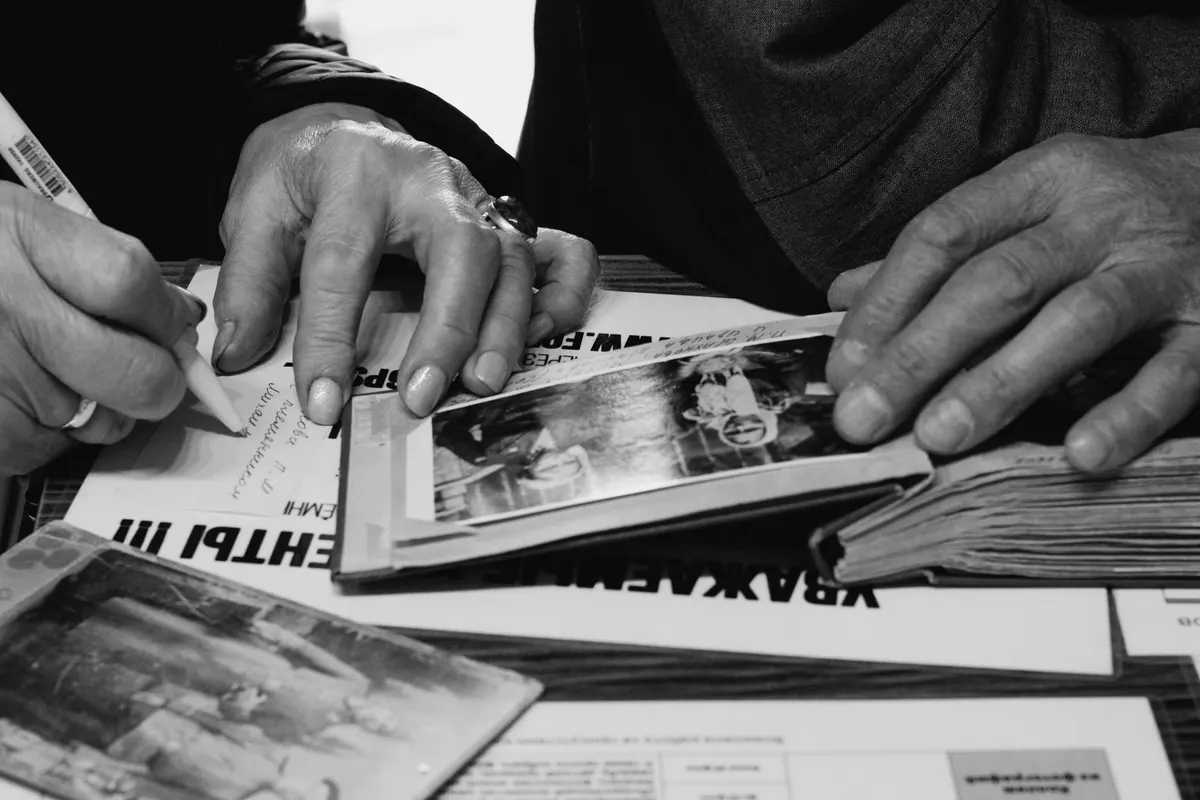
- Hands at work. Close, unposed, busy. Hands carry more information than faces in a working scene.
- A wide frame that shows scale. How many people came, how big the room is, how much is left to do.
- One portrait of someone who is always there. Not a headshot — them in their spot, with their tools or their clipboard.
- The in-between moment. Tea break, queue for the toilet, someone laughing at a joke you did not hear.
- A detail that carries meaning. Worn gloves, a paint-stained cloth, the sign-in sheet, the stack of chairs at the end.
- The result, and one frame after the result. The finished thing is rarely the real ending. The sweeping up is.
Three habits that make the shooting easier
Turn the camera both ways — verticals for people, horizontals for places — so the edit has room to breathe. Get one step closer than feels polite; community photography is usually too far away, not too close. And stay twenty minutes after the event officially ends. That is when people relax and the pictures get better.
Shoot for pairs, not for singles
While you are working, think about how each photograph might sit next to another. The same person at the start and the end. A wide view followed by a tight one. A full room and then a single empty chair. These relationships are what an editor builds with, and they are much easier to find if you are looking for them on the day rather than three weeks later.
It also helps to keep a frame count in your head. Sixty considered photographs will beat six hundred frantic ones, because you will actually know what you have. If you can, pick one vantage point and return to it at intervals — a doorway, a corner of the plot — so the essay has a spine running through it.
Sequencing: the edit is where the story lives
Do the first pass alone and do it slowly. Lay the pictures out as thumbnails on a screen or as small prints on a table, and pick for the story rather than for your favourites. The photograph you are proudest of is often the one that breaks the flow.
A reliable shape for a short community essay runs like this:
- An opening frame that establishes place and mood.
- Two or three frames that introduce people and the work.
- The middle, where effort, friction or scale shows up.
- A turn — the moment something is finished, changed or handed over.
- A closing frame that leaves a little air in the story.
Then test it. Cover each image with your hand. If the essay still makes sense without it, cut it. Vary the rhythm — wide, close, medium, wide — and avoid putting two similar frames side by side. Show the sequence to one trusted person and watch their face rather than listening to their opinion.
Captions that do real work
A caption should answer who, what, where and when, and add the one thing the photograph cannot show. Do not describe what is visible. Do not use the caption to tell people how to feel.
Weak: A volunteer plants seedlings in the community garden.
Better: Maya, who has run the Wednesday session since the plot opened, planting kale she raised on her windowsill.
Spell names correctly, which means writing them down at the time and reading them back. Keep a small notebook or a note on your phone as you shoot — the half-sentence you scribble at 11am is worth more than an hour of trying to remember in March.
Your first essay: a two-hour assignment
Choose something small and recurring rather than a one-off spectacle: a repair café, a choir rehearsal, the last week of a mural. Give yourself two hours, sixty frames and ten final images with captions of no more than two sentences each. Finish and share it within a week.
Show it to the group first. Ask whether the captions are right, whether anyone wants a picture removed, and how they would like to be credited. Give them copies — prints, a link, a cheap zine stapled at the corner. The point of a community photo essay is not to win anything. It is to hand a group a version of itself it can keep, and to prove that the ordinary Thursday night was worth looking at properly.
Photo: Plato Terentev / Pexels