10 Common Mistakes to Avoid When Hanging a Community Art Exhibition
The night before an exhibition opens, the room always looks worse than it did at the planning meeting. Pencil marks on the wall, a roll of tape on the floor, somebody holding a spirit level at arm's length and squinting. Most of what goes wrong on hanging day isn't a failure of artistic judgement. It's a handful of practical decisions made too late, usually by people who are tired and hungry and want the doors open.
None of these are hard to fix. Here are the ten mistakes that catch community groups and small galleries most often, and what to do instead.
1. Running everything along a single centre line
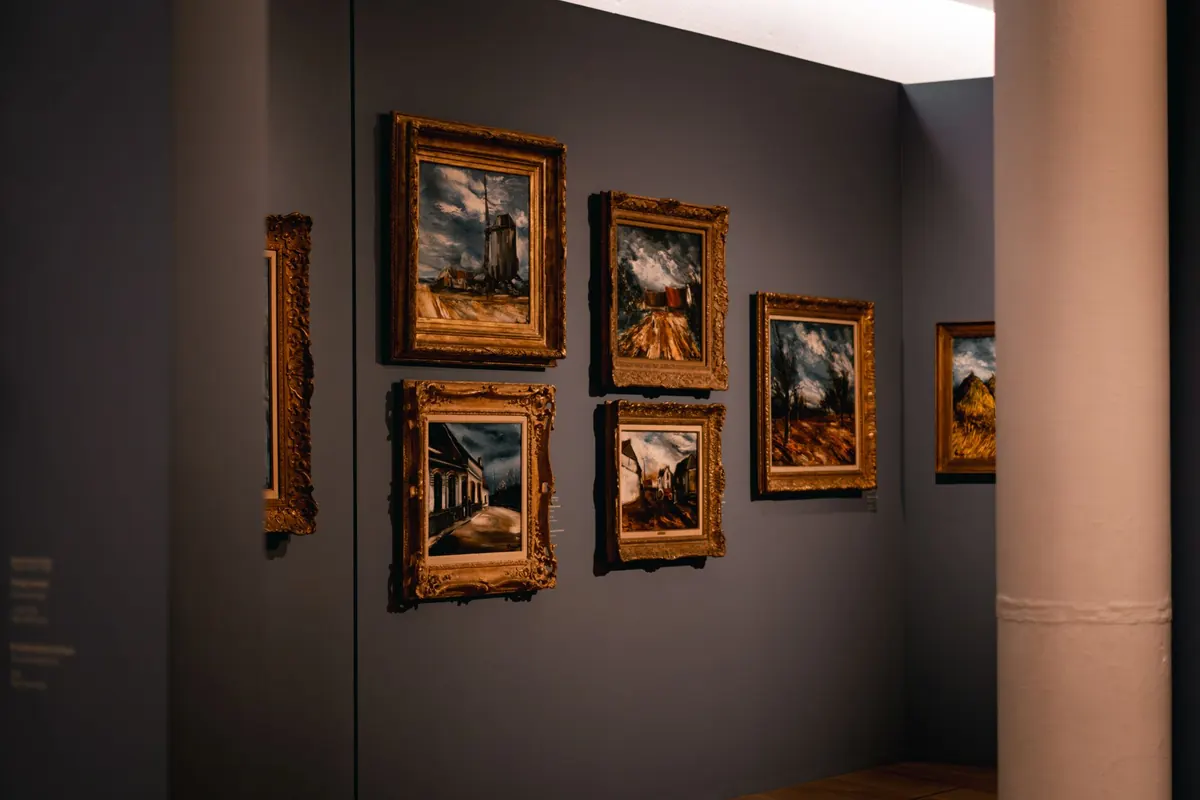
A uniform centre line looks tidy on paper and awkward on a mixed wall. It works beautifully for a consistent body of work—a photography series, a set of prints the same size—but it flattens a show where a large painting sits beside three small ceramics.
Instead, group works and give each group its own logic. Keep a consistent centre line within a group, then let the next group reset. A general starting point for adult audiences is a centre roughly 145–155cm from the floor, but check it against who is actually coming. A show by a primary school art club and a show by a life-drawing group should not hang at the same height.
2. Filling the wall instead of composing it
Empty wall is not wasted wall. When people hang to fill space, the work starts competing with itself and the eye has nowhere to rest. Leave a clear margin at the corners of a wall and at least a hand's width between pieces in a tight salon hang—more between larger works. Align tops or centres deliberately rather than by accident, and stand back every three or four pieces. The floor is your proofing tool: lay the whole wall out flat before anything goes up.
3. Treating labels as an afterthought
Labels are the part of the show visitors actually read. Typed the morning of, printed on thin paper that curls in a warm room, taped at a different height under every piece—it undoes months of work.
- Include the essentials: artist name, title, year, medium. Add one short line if there's a story worth telling; not a paragraph.
- Place them consistently. Bottom right, a fixed distance from the frame, every time. Visitors learn the pattern in ten seconds and stop hunting.
- Make them readable. Body text around 14–16pt, dark on light, matte card so it doesn't catch the spotlights.
- Plan for access. Keep a large-print copy of all labels at the door, and make sure anything delivered by phone or screen isn't the only way to get the information.
4. Lighting the room rather than the work
Spotlights aimed straight at a framed piece produce a hot rectangle of glare and hide everything behind the glass. Angle fittings across the surface instead, roughly 30 degrees off the perpendicular, and check the effect from where a visitor will actually stand. If the space has windows, walk the room at two or three times of day—afternoon sun can turn one wall into a mirror and another into shade.
Evening openings need their own check: a room that looks fine at 2pm can look gloomy at 8pm. Where fittings allow it, keep lights a sensible distance from paper, textiles and anything fragile, and never place a hot lamp close to a flammable surface.
5. Designing for the average visitor who doesn't exist
Walk the route as someone using a wheelchair, pushing a buggy, or holding a walking stick. Then fix what you find.
- Keep walkways clear—aim for at least 1.2m where the space allows, and never block fire exits, sockets or radiators.
- Leave standing room in front of each work so someone can stop without being in the way.
- Provide at least a couple of chairs. People who can't stand for twenty minutes will otherwise leave early.
- Keep labels and comments within comfortable reach; nothing important above head height or below knee height.
6. Assuming the work will look after itself
Community shows are usually run by volunteers on an invigilation rota, and that's fine—as long as there is one. Don't leave a room of borrowed work unattended during opening hours. Note the condition of each piece on arrival, photograph the finished hang, and record who collected what at the end.
Use fixings rated comfortably above the weight of the work, with two points for anything large or heavy. Small, pocketable pieces belong in a case, and cables should be taped down before someone trips. If you are unsure about insurance cover for borrowed work, ask the venue what their policy includes and whether your group needs its own—that's a question worth putting to a broker or adviser rather than guessing.
7. Skipping the walk-through
Before the doors open, hand someone a clipboard and ask them to enter as a visitor would. They follow the natural route, read every label from standing, sit on the chair, look for shadows. Meanwhile, one person does a slow sweep with a cloth: tape residue, pencil marks, crooked frames, an empty hook nobody claimed.
Then write down the takedown plan—date, time, who has the van, who is contacting artists—and put a copy somewhere other than the organiser's coat pocket. Hanging a show well is mostly logistics and a bit of empathy. Get the small, boring things right early and the work gets the room it deserves.
Photo: Josue Canceco / Pexels